Pond liners - Biologists building guide: price Fish pond liners to sealing or lining fishing ponds & lakes cost to build
Biologists' help tips how to install pond liners from garden pond liners for large ponds, fish ponds and large fishing pond liners, we cover rubber & plastic pond liners vs natural pond liners and sealing a pond natural way.
 |

Lake Pond and Stream • Planning • Design • Construction • Management |
|


For every page "Like", we plant a wildflower on a lake or pond (see here) Follow us for seasonal advice.
|
Pond Liners Guide by Biologists
Introduction to lake & pond liners
The seal of a pond or lake is similar to the foundation of a building; what happens here affects everything above the liner or seal. Many people think a pond liner has but one function: to hold the water in the pond. In reality, there are other critical functions that help keep water clean and reduce the cost to build a pond / lake. We do not need to get into the science of sediment chemistry here since the intent of this discussion is simply to help people decide what method to utilize to seal their ponds and lakes.
As Aquatic Biologists we design ponds, lakes and streams everyday. Since we do not market pond liners we offer this guide in the public's interest. This sets us apart from most people in the pond and lake industry. Our profession is to design and develop the best man-made aquatic habitat; it isn't to sell products.
Different pond liners for different ponds
To select an appropriate pond liner, the goals of the pond or lake project need to be considered carefully. Aspects of the pond such as size, quality goals, budget, property value, species of fish, longevity, geology, wildlife, maintenance and the level of knowledge of the pond designer need to be considered. The following section describes the benefits and weaknesses of three categories of pond liners.
video montage of the natural ponds & lakes we build
Pond liner longevity is a very important consideration in pond liner selection. Sealing ponds with clay tend to last at least centuries due to the stable inorganic mineral nature of clays that survive through geologic time much like their parent rock material. Synthetic pond liners usually have a twenty year warranty because they break down with exposure to sun and soil processes. While it is good for the pond liner manufacturers to offer a replacement liner, much more work is required to reinstall it if the goal is a pond to last a lifetime. Few unprotected plastic or rubber pond liners stand up to sharp animal claws or hooves, nor should the manufacturers be expected to support their products under these circumstances. Pond owners need to forecast their need for longevity in order to make an appropriate selection.
Rubber pond liners or plastic pond liners are relatively inexpensive for small ponds. They also are not generally expected to last more than ten years in a casually constructed or poorly designed garden pond that is exposed to animals with sharp claws. Protecting the synthetic pond liner with soil, sand or smooth rock will protect the pond liner enough to likely double the life expectancy of the pond liner. Consider that extra care and a couple more layers of protective underlayer need to be employed to prevent damage to the liner during pond construction. If you know you will build a more permanent pond later then a plastic liner may be the way to go in the interim. If you are building something to last a lifetime, then one of the enhanced earth or clay pond liners may be more appropriate.
Sealing a large pond or lake project should be built with the idea of the seal lasting at least as long as a well built house and not just a couple decades since a lake is much more expensive to fill-in or repair. Few people invest in a quality home expecting to replace it in twenty years. The same can be said for moving into a community on a man-made lake that is sealed with a synthetic or plastic pond liner. Unbeknown to so many homeowners in these residential developments is they are either going to incur much higher costs to keep their lakes full (including purchasing additional expensive water rights), or they are going to have to reseal their waterfeature. We have yet to see a residential developer offer to rebuild a lake after the property is sold. A lake will become an appreciating asset if it is expected to last lifetimes. If it fails within a decade or two, it becomes a cost instead of an investment.
While Spring Creek may be the only company building natural clay lined small ponds, sealing a pond with concrete is another sealing method that, when properly built, will last quite a long time with normal use / abuse. We say properly built because poorly installed concrete is not a good choice for longevity. They may be more expensive to install than plastic liners in small ponds, but they pay off over the life of any pond built to survive more than a couple decades if built correctly with improved modern concrete.
Types of pond liners
Synthetic & Rubber Pond Liners
These days when pond liners are mentioned, many people think of the various forms of plastic and rubber pond liners that have become popular recently. Synthetic pond liners have allowed a vast number of inexperienced landscape contractors and hobbyists to create inexpensive small ponds. The reason we point out the small ponds is because as the size of the pond gets past the backyard "puddle" size range of most garden ponds, the cost of installing these liners, along with careful ground preparation and a protective underlayment, becomes increasingly expensive. Extreme care is also required when placing habitat features such as stones or logs over the top of these liners.
Small ponds designed as fishless water gardens lend themselves to synthetic liners since their health is not being challenged by elevated nutrient loading associated with artificial feeding in many ornamental ponds such as koi ponds. These supplementally fed fish ponds are the situations where most people employ various forms of filters. It is also important to note that synthetic lined ponds where fish are being fed, can be expected to require periodic cleaning - often annual cleaning in simple or poorly designed ponds.
Plastic or rubber pond liners do not easily lend themselves to a natural look nor a naturally functioning pond habitat even though there are many who claim these ponds are "natural", at least for marketing purposes. They tend to be very slick and do not easily hold natural elements in place without a lot of extra materials that raise the cost of building a pond. More than any other type of pond, we hear about owners cleaning their plastic ponds out once a year or more or they change their water frequently or use pond additives to avoid the ponds' inability to maintain itself. Again, this will depend upon the quality of the pond design. Yet from a budget outlay standpoint for small ponds when the goals are more short-term, synthetic plastic pond liners are a viable choice.
Rubber pond liners
EPDM pond liners are very popular as water garden or garden pond liners. While they are more expensive than plastic pond liners, they tend to be more flexible and conform to the contours of small water features quite easily. They are not as strong as some of the flexible plastics, but rubber pond liners are easier to handle in tight spaces. This lends to rubber pond liners popularity in small garden ponds.
Plastic pond liners
There are several plastic pond liner materials available. Plastic liners tend to be less expensive than lining a water garden with a rubber seal. Many of the less expensive plastic pond liners do not enjoy a reputation for longevity. For sealing larger ponds, some of the plastic pond liners are mechanically stronger than rubber pond liners, but these plastic pond seals tend to be stiff and more difficult to manage in small ponds. Both plastic and rubber pond liners require much greater time and care during pond construction due to their fragile nature when presented with heavy equipment and large rock.
There is another rarely considered unseen concern with plastic and rubber pond liners. That would be the warranty. Rubber and plastics break down with time and exposure to soil, water and sun. The most popular warranty is roughly 20 years, users need to consider the value in a warranty that refunds the price of the liner when the entire pond needs to be rebuilt since most of these liners are buried beneath rocks and soil. Pond restoration might be avoided by placing a clay seal under the rubber or plastic to ensure against its short life span. This does bring up the question of needing the second seal. If 10 to ~30 years is the goal, then there is less concern about longevity.
As an aside, we are seeing a couple plastic rubber lining companies write advice pages for those wishing to build a lake. Of course they suggest using their products. Many construction companies also use them. Why? Because they can charge more money for the project. We would like to see a habitat designed by liner manufacturers that could keep up with our quality.
Enhanced soil pond liners
Soil additives such as sodium bentonite clays and a chemical product known as ESS13 are much less expensive than synthetic liners, especially for large ponds and lakes. One consideration for this type of material is the need for an experienced applicator in order to ensure a quality seal for the pond or lake. This only slightly reduces the larger cost savings of soil sealants compared to synthetic pond liners, but even with the professional help, these soil sealants are usually significantly less expensive to use than the synthetic liners. Reiterating from earlier, soil and clay liners in the right hands will produce a pond seal of several lifetimes when property investment is important.
There are a couple other advantages to soil sealants and natural clays in that they offer an ability to absorb and trap huge amounts of excess nutrients, plus a thick layer is going to be much more fishing lure, dog, horse, cow, deer, moose and elk proof.

|
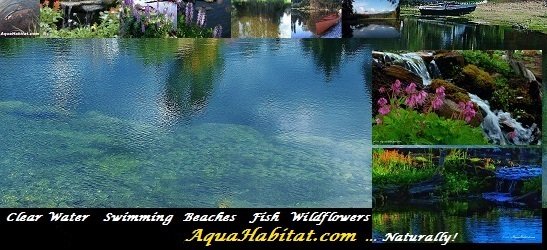
| An example of the water quality our lakes and ponds exhibit when sealed with clay. For investment quality natural habitats, clay passes the test for longevity, aesthetics and water quality. View more |
Natural clay pond liners
When high quality clay is available it forms a nearly bullet proof pond or lake seal. It is less tricky to install when compared to bentonite clay or ess13, but finding quality clay and importing it to a site can become a costly proposition. These clays weigh much more than ess13 or bentonite, so in order to compare favorably with the enhanced soil sealants, clays need to be on site or in close proximity. The durability and longevity of the finished seal is on a par with the enhanced soil sealants, so the decision usually comes down to economic factors. Clay to be used to seal a pond should be evaluated by an experienced Soils Scientist or engineering lab since what may look like clay to an inexperienced eye may not always be high enough quality clay to seal a pond. There are numerous varieties of clay; not all of which will prevent water seepage. Knowledge or testing is required to recognize the difference.
On some small ponds, we will often spend more money to find a high quality local clay since the cost of importing small amounts of sodium bentonite or ess13 can be relatively expensive. We use different and very specific techniques to seal various size ponds with clay or soil sealants.
In summary, regardless of which method is selected to seal a pond, the design requirements to achieve a completely naturally appearing body of water follow similar scientific principles. While a synthetic liner may generally produce a body of water that appears more clear over the short term, time will catch up with this sort of pond liner in that they tend to exhibit even more problems with weed growth than the other pond sealing methods. Natural clay and enhanced soil pond liners may require skilled hands to install, but offer long term real estate value appreciation instead of cost.
As always, the goals of each project will dictate design and construction methods. Our goals and our typical clients' goals tend towards longer term investment. Everyone's goals are unique.
Pond liner cost of construction
As mentioned earlier, the enhanced soil pond liners and natural clay pond liners can last at least several lifetimes. There is another factor to consider in the cost of pond construction: durability. In a clay lined pond or lake, heavy equipment can run at will over the pond seal without damage. If a boulder is dropped on a clay sealed lake bottom, it is of little concern. In a rubber lined or plastic lined pond, that same boulder will require work to stop in order to test the synthetic pond seal for damage. Working over a synthetic pond seal is more tedious, thus slower and more expensive. Much more care is required for plastic lined pond construction projects.
Pond liner price
When shopping for a pond liner there is a larger perspective that is very important to consider beyond the retail price of the liners: the impact of the cost of a pond liner on the total price for building the pond or lake. While the price of sealing a pond requires several considerations, make sure the impact of the selected pond liner on the cost of the pond is estimated before deciding on which method to use to seal a pond. Logically, spending more on a pond liner in order to reduce the total pond construction budget is money very well spent.
Three considerations for pond construction will be: is the pond going to require an underlayment and overlayment protection of the liner? What do these protective layers cost? How will the strength of the pond liner fare under pressure from large rock and equipment? How about ground settling and earthquakes? Finally, will the pond building contractor charge more to work with a more fragile pond liner material?
Ultimately the selection of pond liner material will depend on the techniques and pond design talent of the pond builder. It is our professional experience that plastic or rubber pond liners are less expensive for very small ponds and enhanced soil or clay pond liners are more cost effective for lakes and large pond liners. With that said we do have our particular preference based on our pond designs for small ponds that are much more effective than common pond designs in use in the garden pond industry. Our particular design techniques utilize very elegant science instead of technology to create the highest value ponds and lakes, thus affecting only the portion of the public we serve.
Finally what is the average retail price of a lake or pond liner? For garden fish or koi ponds figure a cost of $1.00 per square foot. If you need underlayment protection, add 25% to this figure. To create a more naturally appearing pond add another 25% for an overlayment that hold soil. Large pond liners will see a slight decrease in price. For natural clay seals of the same backyard ponds, use the same figure unless the pond is very small, then it may cost $1.50 per square foot. The cost of a plastic or rubber liner for large ponds and lakes will run in the range of $40,000 to $45,000 per acre when using rubber or plastic. This includes the cost of the underlayment protection. The cost to seal a lake in natural clay or bentonite will vary depending on the distance to the source of the clay. We generally see a cost range of $5000 to $16,000 per acre or about one-third of the synthetic liners.
Ponds without pond liners
Yes a pond can hold water without a pond liner. Since shallow ponds of a couple feet experience less head pressure from the water, they may not require a dedicated liner. What they do require is dense silt soil that is well compacted. This is the usual type of soil that forms hard dry dirt clods. We have described a bucket test to tell if soils can hold water with just a foot or two of head pressure above the seal. Visit our pond construction costs page for details. When the depth of the water in a pond or lake gets deeper than a few feet, the water pressure on the lake seal starts pushing water through the liner faster. This is important if the water supply is limited. There is a range of scientific reasons that garden ponds can benefit from an earthen seal even though very few installers know how to build these natural water features. We do build these sorts of habitats.
Pond site evaluations
We are available to assist with your pond and lake construction decisions. We also help people find the best waterfront property to buy. We can help you work through site challenges such as which earthen, clay or synthetic liner is most appropriate for your site, how to deal with fluctuating ground water levels under a plastic liner or which synthetic liner material is most appropriate for the circumstances. We will evaluate your local soils for earthen or clay pond sealing qualities and recommend appropriate methods to seal your pond or lake depending on your site circumstances and water supply. Sending a soil sample for evaluation is a very good first step to ensure the success of your project.
We are also available to evaluate the effectiveness of a proposed lake or pond design, or redesign your pond plans to more effectively reach your goals.
FURTHER READING...
- Photo Gallery of our waters on Google Photos
- Visit our discussion on Facebook.
- Continue your pond or lake design process.
- Learn how to invest in waterfront real estate in the waterfront property buyers guide
- See how we are saving sensitive species of fish, wildlife and wildflowers in our clients' private refuge habitats. Our private refuge program for rare and sensitive species
- All about Building natural ponds / lakes to avoid mosquitoes
- Our other FAQs page to efficiently build a pond
- Common myths to avoid in lake & pond construction, especially trout ponds
- trout ponds: the ultimate fish habitat
LINK BACK TO US
How linking to us helps you get better answers! It's very easy.
We look forward to discussing the possibilities of bringing your water to life!

| Home | Pond Design Guide | Pond erings | Pond Myths | Fishing Tips | FAQs | Resources | Waterfront Property |

Contact Spring Creek

SPRING CREEK AQUATIC CONCEPTS
Lake Placid, NY Portland, OR Bend, OR
(971) 266 4669
CLAY POND LINERS
clay pond liners: right on line for the long term best pond liner choice of Pond experts and Biologists for POND DESIGN at Spring Creek. using Clay pond liners in a natural pond design require a lot more knowledge to apply and seal a pond, but lining a pond with clay cost less than to seal or line a pond with rubber or plastic pond liners. This is especially true for natural swimming ponds Natural Clay pond liners also keep water cleaner for natural clear water pond construction long after rubber pond liners have failed. We can build a habitat with a clay pond liner or rubber, but the extra lining elements required when creating a rubber lined pond for long life are much more expensive. When you think of natural ponds, do you consider clay sealed or plastic lined ponds more natural?rubber pond liners
the use of Rubber pond liners will be lining up if you only expect the rubber pond liners to last around ten years or less on poorly designed pond habitat. Since all of our clay lined pond seal projects are designed to last several lifetimes, we prefer to seal ponds with clay. In the case of fishing ponds and especially trophy trout ponds there are no worries about fishing hooks causing a pond to leak. Ornamental fish ponds don't have to worry about fish hooks, of course.CLAY LAKE LINERS
lake construction contractors need to know much more about how to seal a lake due to the size of the lake they are building and the cost of water supply. building lakes are the big leagues for fishery consultants As the price of building a lake goes up, the knowledge required to minimize lake building costs is paramount. design including fish pond liner design to trout pond liner design by Biologists. Lined Pond design advice and tips. pond construction and design Building a pond does not begin with construction. it starts with careful pond planning, then pond design and finally construction as large ponds become small lake construction projects. no matter what you call natural ponds, earth ponds & clear ponds or earthen, they are all the same ponds without liners made of plastic. Looking back through the history of ponds and lakes lends several clues of how to seal a pond These are important to know when the topic of fishing pond construction comes up since fish hooks are no friend to plastic. Read about our trout fishing tips. Consider our knowledge for investing in lakefront property - waterfront land ponds for sale - fly fishing property for sale Before buying lake property it's best to know about the lake and how it was sealed or lined. We evaluate lakefront real estate for careful investors. landscape ponds & swimming ponds yes we just said swimming in landscaping ponds that means why have a pond that looks like a flooded pool? landscaping around ponds & lakes is critical to aesthetics. natural lake & pond construction contractors More info on natural clay plastic and rubber- aquatic lake consultants The larger the lake, the more one needs to know to make the best investment.
- trout habitat always is best with natural clay sealed lakes and ponds. Rainbows and brookies are sensitive to pollution due to poorly sealed ponds.
- farm pond construction is usually done with no seal or a clay seal due to size and low budgets for farm ponds.
- ponds images Look through our photos of ponds and lakes. they are all sealed in natural clay.
- trout pond for browns, rainbow, cutthroat and brookies. Some of our naturally designed beautiful and efficient
- trout ponds are built by Oregon's premiere heavy construction company
- Oregon Kerr Contractors They know how to build to our designs.